Technical Due Diligence
& Audit

The technical due diligence to protect your investment
Are you about to finance or acquire PV projects in development phase or already built and in operation? Are you a developer, an investor or a lender?
The Technical Due Diligence phase is fundamental to identify and mitigate the potential risks associated with your future investment, whether it’s a single project or a portfolio. Bluevolta protects your interests by providing independant technical expertise. The typical aspects which are scrutinized during a due diligence are presented below.
During the site visit, the following items are examined : access, grid connection point, presence of obstacles creating potential near or far shadings, topographical and environmental constraints.
If the project is already built, a thorough site inspection is conducted to verify the quality of the construction and to ensure the compliance with the best industry practices in terms of installation quality and safety.
Engineering and design documentation is reviewed to check that the main plant components are properly sized and that key equipment selected is suitable for the site’s environmental conditions (maximum wind speed, extreme temperatures, etc.).
Technical specifications of key equipment are also reviewed (performance, technology, manufacturer’s warranty conditions, compliance with international standards) and commented with regard to the current technology state of the art.
We will also verify that all necessary preparatory studies have been properly carried out : soil and structural studies, grid impact studies, where applicable.
The aim is to ensure that the project has obtained all the authorizations required for the construction and operation of the plant. The technical aspects of the following documents are examined : lease agreement, building permit or planning permission, operating permit, grid connection agreement, power purchase agreement (PPA), etc. The legal part of the regulatory analysis is generally carried out by a legal advisor.
When the project is located outside France, Bluevolta works in partnership with local companies who are familiar with the regulatory context applicable in the country where the PV project is located.
A new and independent energy yield assessment is carried out to compare the results with the initial study carried out by the project developer. First, an analysis of the solar resource is performed to select the most appropriate database for the plant’s location.
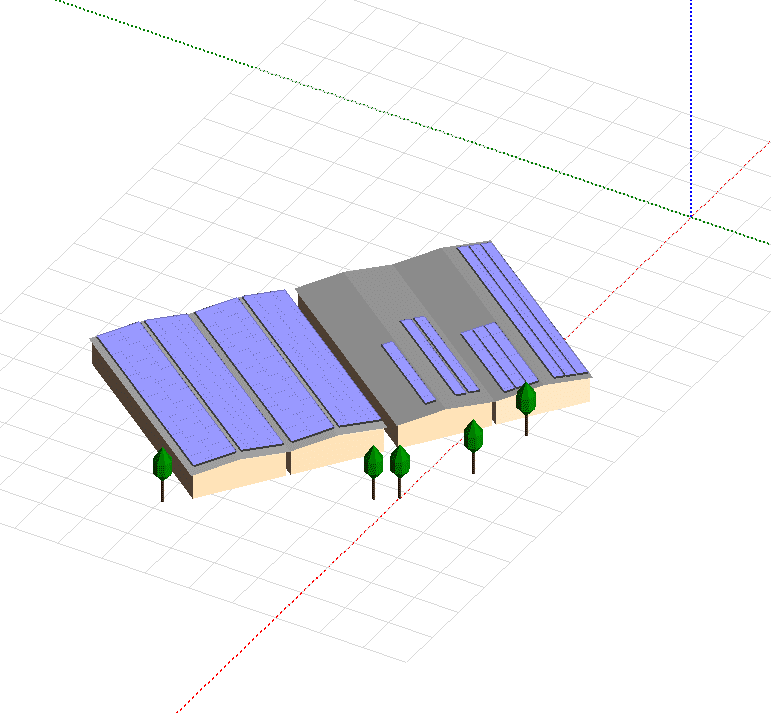
The actual plant design is then modeled within the software PVSyst with the selected equipment (.PAN and .OND files). Each technical assumption is justified. Uncertainty analysis will be conducted to derive the statistical values P90 and P99 of the energy production.
In some cases, only a review of the existing energy yield assessment will be conducted depending on the contractual scope and project requirements.
The EPC (Engineering Procurement Construction) and O&M (Operation and Maintenance) contracts will be reviewed in detail, with a particular focus on the following aspects: verification of proper contract structure (presence of essential clauses), clear identification of exclusions and interfaces, verification of delay and performance liquidated damages, adequacy of provisional schedules, verification of technical, material and human means, verification of payment milestones, acceptance conditions, performance tests and commissioning.
Particular attention will be paid to the performance guarantees offered for both the equipment and the plant’s long-term performance.
For projects already in operation, an analysis of actual performance since the commissioning will be carried out and compared with the plant performance guarantees.
Based on the previous phases of the due diligence process, we assess if the technical inputs used in the financial model are suitable and matching the project specifics (annual yield, degradation, etc.) and we provide an expert opinion on the costs (CAPEX and OPEX).
Production data since commissioning are analyzed and compared with initial yield simulations and contractual performance guarantees. Performance indicators such as Performance Ratio and Availability are calculated.
In addition, maintenance reports will be checked to ensure that the plant has been properly maintained.
The final step of the Technical Due Diligence process is to prepare a matrix listing all the risks identified during the study and classified according to their degree of impact.
For each risk, and where technically justifiable, mitigation measures are formulated to give the transaction the best possible chance of success.
After the due diligence stage and once the transaction has been completed, we offer to continue our support for the monitoring of the construction and the performance evaluation during the first years of operation.
We have a long experience acting as Lender’s Technical Advisor!
A performance audit to enhance the long-term value of your solar assets !
Are you an Independant Power Producer (IPP) who suspects that your PV power plants are underperforming?
We can carry out a diagnosis to identify the causes and propose corrective actions.
As a first step, we carry out a detailed analysis and review of all available data: production at inverter level (or per string if available) and at the connection point, alarm logs, maintenance reports, weather station measurements (irradiation and temperature).
A site visit can also be organized to visually identify any material defects or malfunctions. Depending on the results of the analysis and visit, further investigations may be recommended on site (infrared thermography, I(V) curves) or in the laboratory if necessary (flashtests, electro-luminescence).